 |

 |
|
|
Checking Expectations at the Door in Uganda
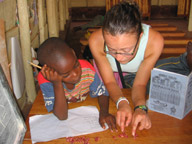
5 January 2006 Had she approached the trip differently, she might have come back disappointed. But Amber Burridge, a resident of Calgary, knew that to travel and work in Uganda any other way would spell disaster. In fact, she had been warned. "I had a friend that had gone to Malawi and she told me to expect the unexpected when I was in Uganda," Amber said. "I was told, whatever you expect, things are going to be different. So I tried really hard not to expect anything and to keep an open mind. I just decided to be ready for a world that would be vastly different from my own." Amber volunteered in Uganda for six weeks, where she taught in a primary school and trained HIV/AIDS counselors. The world she encountered in Uganda, was, indeed, like nothing she had ever experienced. "A lot of the volunteers had a hard time adjusting to the culture and how much more laid back and unstructured everything was," she said. "I was often flabbergasted, but then I remembered my approach to the country and tried to take on a new attitude." Despite her best efforts to keep an open mind, Amber was still overwhelmed by the lack of structure and organization in the village and school where she was working. Events never started on time, teachers were often missing from classrooms and school was spontaneously closed. Her first week in Uganda, Amber wandered around wondering what it was she should be doing, and if it was a mistake to come at all. "If I do volunteer work at home, it's like, here's what you do, and if you're not busy, here's some other things you can do," Amber said. "But in Uganda, you had to have a lot of initiative yourself. At first it was difficult because it was intimidating. Once I realized it was largely a cultural thing, it was a lot easier. So I just said, I'm here and I'll do my best." One of the most frustrating things for Amber was the school system, or, as she says, lack thereof. "My first day teaching, I gave all the children books to read so I could find out what level they were at," Amber said. "I realized that everyone in the room was at a different reading level. Some were way ahead and some couldn't read a single word and didn't know the alphabet. It was shocking. The teacher was missing and when I asked the class where she was, they told me she was on a break. When I asked for how long, they told me, 'Until tomorrow.' I thought she was only on a coffee break." As Amber began to settle into life in the village, however, she also began to adopt to the Ugandan way of life, and to use her patience and creativity to make progress in the schools. She kept a journal while she was there, and although an entry just a week before testified to Amber's frustration, a later entry painted things differently: "I've gotten into more of a routine and I feel like I'm really starting to get things done here," Amber wrote. "Teaching at the school, which caused so much frustration for me in the past weeks, has now worked out for the best." In fact, by the end of her stay, Amber said she had made a breakthrough with the children. "The children had never really been taught to read phonetically," she said. "They didn't know that 'A' was 'aah.' They couldn't read any words that they hadn't memorized. So we began teaching them how to read, instead of just guessing. In the beginning, if they saw a word they didn't know, they just skipped over it. At the end, they could actually sound out the word." And by the end, Amber had learned a thing or two from the Ugandan community as well. "They have so little, or what we would consider to be so little, and they're happier than anyone I know here," she said. "It just makes you realize that you don't need all of these things and objects to be happy. It reminded me to take pleasure in the small things. It also made me realize there are such huge problems in the world, and that I really need to not stress about the small things in life, when in the grand scheme of things, who cares? I'm just trying to have a more laid back, thankful attitude." |
 Machu Picchu