 |

 |
|
|
Leading By Example in Russia
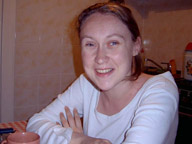
9 February 2006 The 15-year-old Russian girl shuffled when she walked, afraid of giving her legs the freedom to take her where her eyes could not see. She had a small wristwatch that spoke the time and grandparents that dutifully set meals down in front of her. Beyond that, her blindness had blackened her world. So when Colette McNally met the Russian girl while she was volunteering to work with disabled children in Russia, she knew she had come for a reason. Colette is also visually impaired, and over the next four weeks, she began to lighten up the girl's life. "I remember her saying that all she really wanted to do was learn how to slice bread," Colette said. "That was her ambition." Colette had higher hopes for her. "I wanted to help her become more independent," Colette said. "I showed her how to get around a room, how to learn the layout of a new room, how to get through doors safely and how to be guided. It was amazing to help give this girl confidence and to show her that someone else understands. And the work we did will in turn help her grandparents to understand her disability and learn to guide her properly." Colette herself had to learn these skills only four years ago. A diabetic, Colette suffered from glaucoma and lost much of her sight as a result. Her trip to Russia was the first she made on her own since acquiring her disability. Compelled by a need to help on a humanitarian level, Colette volunteered through the Global Volunteer Network (GVN) last July, where she worked as a mentor, friend and teacher at a centre for disabled children in Yaroslavl, northeast of Moscow. Colette quickly learned that the centre is one of the only sources of intellectual and social stimulation for the children, as services for children with special needs in Russia are limited. Parents are often urged to keep their disabled children at home and societal prejudices make integration difficult. According to the 2002 State Report on Children, over 70 percent of disabled children receive little or no education. Colette spent her time at the centre helping to bridge the gap by playing games, making play dough, dancing and swapping English words for Russian ones. Her own disability, however, sometimes made communication with the children difficult. "Because I couldn't see, I couldn't point to things and have them recognized," Colette said. "I didn't have the confidence to know whether the children were looking at me or not. That's an important part of connecting with them, being able to catch their eye or look directly at them when they're speaking. I tried to overcome that by touching their arm or saying their name or making a movement to catch their eye, or saying any of the Russian words that I knew." Despite some communication problems, Colette thinks she was able to connect with the children on a deeper level because of her disability. "They had disabilities and they could see that I had problems as well," she said. "So I think I set an example that despite my disadvantage and not even being able to speak their language, I was still able to come all this way and do this." Colette certainly had an impact on the young girl. "The most rewarding thing was feeling like I've made a difference for someone else, even if it's just a ripple effect," she said. "When you're working with children, what they experience at this age will affect them for the rest of their lives." Colette is arranging to send some tools that will continue to help the girl become more independent, including a liquid level indicator that buzzes when the fluid in the cup reaches a certain point, large playing card and writing guides. "I think I did help her," Colette said. "After I left, she gave me a set of postcards with a message that was signed from her. It obviously took her a long time because she can't write in a straight line. It took her a lot of time and effort." |
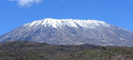 Kilimanjaro