 |

 |
|
|
|
||
|
Itinerary for the South Island Hike2007This safari takes you to areas of New Zealand seldom visited by other travelers. It starts with 4 days of hiking and kayaking in Fiordland National Park. We then head to the Catlins, famous for its beautiful beaches and abundant wildlife - Hector's dolphins, New Zealand sea lions and yellow-eyed penguins. The Dunstan Trail is an old gold mining route that takes us across the Central Otago plateau. Then it's on to the Mount Cook region to view our highest mountain. In South Canterbury we hike to an old musterer's hut. Please note: Since you will need to be ready at the Queenstown Vistors center early in the morning, most International participants will need to arrive a day earlier and arrange their own accommodation that evening. Also, at the end of the trip, you will not reach Christchurch until the evening. Therefore, unless your flight leaves very late that evening, you will need to arrange accommodation for that evening and ensure your flight leaves the following day. Day 1. Join tour in Queenstown - 6km/3 hours hiking  We meet at the Queenstown Visitor's centre at 8.00am and after a short briefing by our guide, head south into Fiordland National Park. This spectacular World Heritage Site is the largest national park in the country and one of the largest in the world. The huge glacial lakes of Te Anau and Manapouri border the spectacular inland coastline that is Fiordland. The area is dominated by water, either in the form of lakes or as falling rain, which has enabled the establishment of temperate rainforest. We prepare for our first hike to Key Summit on the renowned Routeburn track - a fantastic hike of around 3 hours. From here there are fantastic views across to the Darren Mountains. We return to the vehicle and make our way to our camp in the Hollyford Valley.
Day 2. Milford Sound - 8km/4 hours kayaking We rise early and drive through the Homer Tunnel and down to Milford Sound itself. Here we hire kayaks ($82 - optional) and kayak out into the fiord with its cascading waterfalls and views of Mitre Peak (1722 metres straight out of the sea). Fiordland Crested Penguins and New Zealand fur seals often play near our kayaks. After lots of stops for pictures and feeds of Rosco's famous scroggen, we head back to shore and drive back through the divide to our camp in the Eglinton Valley. Day 3. Fiordland National Park - 12km/7 hours hiking This morning we drive to Borland Saddle (1000 metres) in Fiordland National Park where we have lunch and organize food for our first overnight hike. The visual impact of this park is stunning - during the Ice Age, the glaciers gouged the fiords and lakes, hollowed out the rounded valleys, and shaped the granite mountain peaks. There are different forest types all over the park; on the eastern side red, silver and mountain beech fill the valleys, and in the northern sections, podocarp forests of matai, rimu, and totara can be found. From Borland Saddle we climb above the bush line onto the Hunter Range with great views into the Park. We traverse along these tops to Mt Burns (1634 metres - optional climb) and descend to Green Lake to camp. Day 4. Catlins Coast - 7km/3 hours hiking  A leisurely breakfast in this most idyllic site, before hiking out through beech forest and across tussock basins to the road. Have lunch and then drive through to Invercargill for a food shop. This is the southernmost city in New Zealand and its roots, as reflected by its name, are from Scottish settlers who came here in the late 1800's. Many of the cities tree-lined streets bear the names of Scottish rivers. We carry on to Curio Bay in the Catlins, an unspoiled scenic region of coast, rivers and podocarp forest - once an area inhabited by the giant moa (largest bird in the world - now extinct). We relax here and stay in a cozy crib (a New Zealand summerhouse). There is a chance to enjoy a swim in the sea and then a hot shower to complete our day.
Day 5. Cannibal Bay - 6km/2 hours hiking This morning we explore Curio Bay and often see Hector's dolphins, which sometimes surf on the waves. We walk to a nearby tidal platform that contains tree stumps from a fossilized forest 180 million years old - it is one of the most extensive fossil forests in the world. The platforms are a paleontologist's dream. The fossils are evidence of New Zealand's location in the ancient Gondwanaland; plant species identified here are similar to those found in South America. We drive along the coast and reach our next destination of Cannibal Bay. The bay takes its name from human bones discovered here last century that were part of a Maori feast. We have a chance to see New Zealand sea-lion and yellow-eyed penguins, the rarest breeds of sea-lion and penguin in the world. We camp near the beach and prepare a hangi feast (Maori earth oven). Day 6. Central Otago - 6km/3 hours hiking Today is a traveling day. We spend most of the day driving through the spectacular high country landscape of Central Otago. During the nineteenth century, it was the lure of the gold that brought thousands of diggers to the Dunsten goldfields and places like Gabriels Gully where we stop for lunch and a swim. Today it is liquid gold in the form of vineyards that lures people to the area. Central Otago contains some of New Zealand's largest high country sheep stations, many measuring tens of thousands of hectares. We drive up alongside Lake Ohau and then pack gear for a short hike up through beech forest to a camp beside Freehold Creek, just below the bush line. Day 7. Ohau Range - 14km/7 hours hiking  Up early, we leave our camp and head off with day packs to explore a beautiful basin filled with tarns (small alpine lakes). The basin contains an incredible variety of alpine plants, including Spaniards (prickly), and the world's largest buttercup, named Mt Cook Lily (Ranunculus lyalli), because of its large round lily-like leaves. The fit can climb up onto the Ohau range (1915 metres) to glimpse the views of the Southern Alps, including Mt Cook, and the Mackenzie Basin. We return to pack up our camp, and head out to the vehicle. We then drive on to Mt Cook village to camp beneath New Zealand's highest mountains.
Day 8. Mt Cook National Park - 8km/5 hours hiking We set off early with day packs to hike up to Sealy Tarns and Mueller Hut for views of the Hooker and Mueller glaciers, Mt Sefton icefall, and truly spectacular views of New Zealand's highest peak, Aoraki/Mt Cook - 3754 metres (the Maori name translates to 'Cloud Piercer'). On our walk we'll learn about glaciers, mountain building and the New Zealand climate. We descend back down to our vehicle and drive to the bottom end of Lake Pukaki - artificially raised 30 metres for hydroelectric power generation. This lake is a beautiful turquoise color caused by the fine glacial silt suspended in the water. We camp on its shores, with beautiful views across to our highest peaks. Day 9. Mt Somers - 5km/4 hours hiking Continuing through the Mackenzie Basin, an area named after a legendary sheep rustler, we pass Lake Tekapo before reaching our destination, Mt Somers. We rock-hop up a river canyon and climb out to Trig Point with great views into the Rakia Basin. There are several altitudinal plant sequences during our hike, along with regenerating beech forest. We frequently see the New Zealand falcon flying in this area. Tonight we stay in a hut and enjoy a bush sauna and an invigorating dip in an icy mountain stream. Day 10. Tour ends in Christchurch - 5km/4 hours hiking We spend our final day together exploring water caves (you get a bit wet!), Tri-falls stream and swims in Emerald Pool or under a pounding waterfall known as the 'Spa'. Before leaving this beautiful park we'll have lunch and then hike back along the canyon rim to an abandoned coal mine to explore some relics. It's then a short drop back to the carpark. After cleaning up the vehicle and sorting our gear we drive across the Canterbury Plains to Christchurch. We arrive in the early evening. |
|
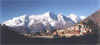 Climb Everest In October 2006 you have the opportunity to raise money for the Nepali Children's Fund. We're climbing the Base Camp of Mount Everest and you have the opportunity to join us.