 |

 |
|
|
|
||
|
James Bousquet writes......about his experience while volunteering in Uganda.I tried not to have expectations, but we of course can't help it. Especially when we don't know what to expect, which was the case for me since this was my first time in Africa. We get so many different impressions from various media and friends. And who knows what one specific project will be like? So I guess I tried to prepare for everything, and consequently was quite excited when I arrived. The loneliness of being the only "mzungu" in the village, in spite of all the attention that generates, had a major impact on me during my volunteer time. Also the conditions of the civil infrastructure (e.g. water, rubbish, electricity and especially roads and transportation). The casual attitudes (or in some cases ignorance) regarding safety standards (e.g. seat belts, construction safety equipment, vehicle emissions). Students being caned by teachers. So many promising young people not having access to a proper education. (My wife and I have the support of friends and family in supporting one particularly talented girl through her A-levels at a good school.) The heartbreak of knowing that their society has little to offer most of them in the way of careers anyway. Maybe the biggest thing is that how in spite of everything these people can manage to appear happy and relaxed, rolling with whatever comes their way. Many of them have known terrors that I'm lucky to say I can only imagine. I'm now working to adopt and maintain their relaxed attitude in my own life. I worked with a CBO named VOLSET. VOLSET's mission is in children's aid, HIV prevention, computer and vocational training, community-based health care and development promotion. My time in Uganda was divided into two roughly equal chunks: about a month in Ntenjeru village, and another month in Nakaseke, north of Kampala. In Ntenjeru I was involved in many things. I handed out graduation certificates at the JIM Educational Centre near Kiyunga, a primary school where VOLSET has placed several sponsored orphans. I configured computer equipment at VOLSET's office in Ntenjeru. I also purchased and donated an up-to-date computer, monitor and UPS to VOLSET so that they could use a new scanner donated by an earlier volunteer. I assisted with building a latrine and a house for the vocational training centre that VOLSET is building near Ntenjeru. I made scale plan drawings of these two existing structures as well as drawing and helping design a few more buildings (including a clinic) that the VOLSET coordinator (Festus Bazira) has in mind. I also gave a speech (about 15 minutes) at an HIV/AIDS workshop for invited community leaders from various parishes in Ntenjeru sub-county. While my efforts in Ntenjeru were certainly appreciated, frankly I sensed that Festus didn't really have a work plan for me. Often it wasn't clear what I'd be doing from one day to the next. This made it difficult/impossible to apply project management skills to any activity in particular, as it took me weeks to get a sense of just what VOLSET's priorities were. In fairness to Festus, he is also forced to be very flexible due to financial constraints and the general level of organization in Uganda. For example, despite his plans to roll out a particular defined HIV/AIDS awareness program, banking delays in clearing the corresponding grant cheque made it impossible to start that work until very close to the end of my month in Ntenjeru. In Nakaseke I taught Senior Three mathematics and Senior Four physics. I enjoy both of these subjects (what a geek) and liked working with the students both in classes and afterwards when they approached me for help with items they found difficult. Teaching was a good project for me because I was could readily get requirements (in the form of the published government syllabus) and could independently develop an approach to delivering on them. I felt good about teaching because I believe strongly in the importance of education and know that there is a shortage of teachers, especially science teachers. At my high school there were only two other science/math teachers for about 500 students at six levels. The Ugandan government is requiring sciences and math to be compulsory at all high schools through to the end of Senior Four by the 2006 school year, so the problem is made more acute by the resulting class sizes. My math class had over 100 students. As for feeling organized and confident, yes I was, except when working on the vocational centre design. I enjoy that sort of thing, but this is a real project and I'm not a real architect nor a structural engineer. But if I feel uncomfortable about that I just remind myself that the builder was pleased to see my scale drawings as he had nothing like that to work with. When he started the existing structures, he and Festus just looked at the ground and marked out where they thought the walls should go. Then they started digging for the footings. Whatever I did has to be an improvement on that! I was in a home-stay environment in both villages, Ntenjeru and Nakaseke. In Ntenjeru I stayed at the home of a very kind 73-year-old gentleman who has a large, well-constructed house and compound. It's a couple of hundred metres up a dirt track from the main road through the village. He has extra rooms with locks and so I had one of those to myself. I was comfortable staying there despite the lack of running water and dodgy electrical supply. Plenty of water from the local borehole was brought to me for washing. My laundry was looked after. The shower and toilet facilities were of course basic, but certainly up to the local standard. All meals were plentiful and well-prepared. After one particularly windy thunderstorm I felt privileged to be staying there. In Nakaseke I stayed at the school where I taught, in a small semi-detached house. A bit more spartan, but still good by local standards. There was a main sitting area, two good-sized bedrooms, and an indoor shower room. Furniture was sparse; my bed frame was bent so I didn't really need a pillow, which is good because I didn't get one. I grabbed a chair so that I could keep some of my items (toiletries, etc.) handy but off the floor. There were more electrical blackouts here than in the first village. I stayed with the Seventh Day Adventist pastor who worked as a teacher, counsellor and chaplain. His son is a student at the school and stayed in the same room with him. The pastor has a daughter who lived in the student dorm. I found communication somewhat more difficult with this pastor although he tried as best he knew how to make sure I was looked after. Food was still plentiful, but even less inspired than usual. Breakfast was served in the staff room at 10:10 and consisted of a cup of bogee. I'm unsure of the spelling, but it's basically a thin porridge made from maize flour, taken hot from a coffee mug. Usually there would be cassava accompanying this. Lunch (at 13:20) was always either rice and beans or posho and beans. Posho (also called ugali) is also made from maize flour and it sort of the consistency of dry mashed potatoes, but with less taste. It's good with the sauce from the beans, or meat if there is any, which there was a few times. Dinner was usually brought rather late by my reckoning, about 20:30-21:00 and was a bit more varied. On weekends I usually went to Kampala to run errands, sometimes staying overnight in a hotel to "recharge." I value highly having had "the village experience," but I think I'd have been better off with my own living space in the long haul. Well, not having to do my own laundry by hand was certainly a bonus. But after a few weeks, I felt some fatigue setting in from living out of a suitcase in someone else's home. When I got to London, one of the great pleasures (after a good hot soak in a bathtub) was being able to cook breakfast for myself. Maybe at my age I need to feel I'm in my own domain, at least after a week or two. But these are my own personal preferences. I was well looked-after overall. I found local transportation to be tiresome, but one could rightly argue that it's part of the African experience. Next time I plan to get my own motorbike. Leslie could perhaps use a vehicle for her trips to the airport, etc. However using public transport is manageable. Some volunteers have their own clear agenda and goals before they leave home. Others like me don't. I think it would help if that is established up front before a volunteer is placed with VOLSET. For those in the second category, make sure that Festus is ready with a more defined project, if not an actual work plan. It's not that I wasn't kept busy, I was. I'm just the type of person who likes to be able to give a clear, succinct answer when asked, "What exactly did you do in Africa?" Nakaseke SDA Secondary School could use teaching aids of any kind. They have nothing except for a small library and plenty of chalk. For example I had a map of the world which I used to point out Canada in relation to Africa and the city I came from. I gave it to the geography teacher. I left a laptop computer (donated by a former employer for that purpose) to add to their two existing machines, both of which had 486 cases, but I never checked what processors were actually inside. (Instructors come from the local library to teach computer skills once per week and bring a few more machines with them when they do.) If other volunteers are lucky enough to have access to old computer equipment like this, it's a big hit just about anywhere. Most sports equipment and lab equipment can probably be purchased in Kampala, so as to save on luggage. But some things that could go a long way in the classroom don't seem to be around. For example, I was teaching about waves in physics class and could have really used a Slinky. The other science teachers know what a Slinky is, and so did the sales clerks at the three stores in Kampala where I went to shop for one before giving up. I watched interscholastic football matches where many of the boys were playing in bare feet. The day I left one boy asked me if I could arrange for used football shoes to be sent over from Canada. Even used running shoes are appreciated. I also left behind some of my used clothing at both places. It lightens the load for the trip home. Basic supplies like pens and erasers are popular with the students. One asked if she could have my calculator. There is much sharing of calculators, especially during tests. It's worth repeating that you might want to be mindful of not creating expectations for volunteers who follow. Not to sound paternalistic, but we don't want to teach dependence. I tried to use these gifts as prizes where possible. While visiting the Kilimanjaro area of Tanzania, which gets tourist traffic unlike where I was in Uganda, it was very evident that previous "western-looking" visitors had been there and given items away. I think I might have felt a greater sense of accomplishment in my work had I prepared in advance with my own agenda for a project and how I would get it done. I originally thought that, to a degree, I'd join in on existing projects that lacked only my skills and labour. Having said that, this was my first time in Africa and I was "getting my African feet wet" as my coordinator, Leslie, and I discussed after my arrival. Knowing so little about how things are done in Uganda, I felt unable to engage effectively in meaningful project management activities. But having had this experience, I'm now better-equipped to take more initiative on subsequent visits. Also, Leslie not only understood but anticipated my concerns. She was generous with her time and thoughtful advice when I sought it. She put me in touch with other volunteers. You have a very good agent on the ground in Mukono. Sincerely, Jim |
|
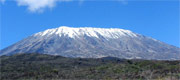
Feature Fundraiser: Mt KilimanjaroIn January 2006 we're climbing Mt. Kilimanjaro as our major fundraiser for the Ugandan Education Fund. Participants will have the opportunity to hike to the top of one of the most beautiful and prestigious mountains in the world, and funds raised will go towards building a school for AIDS orphans in Uganda. more >> |
Legal Terms of Service Designed by: Creative Conscience Tracked by: Opentracker © 2000-2005 http://www.volunteer.org.nz |