|
|
||
|
Jeff Gard writes......about his experiences while volunteering in Alaska.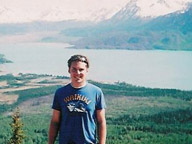 Out in the field! - 6 June 2006
On Tuesday, June 6th I woke up early to make it to meet the other intern who I work with at 6am. The Kenai Watershed wanted us to get water samples to them. We both went to five different locations along the Kenai River through mud flats, wet lands, etc. to get to the water to get the samples. Sometimes we were walking in knee high mud, but we had hip boats which helped a lot. While taking the samples we took field notes: we recorded the location, time, wildlife, weather, and we took pictures upstream and downstream to give better data observation from where we took the samples. After completing our task we went back to the watershed forum to put our samples in a cooler and then we took them to a laboratory. The laboratory will test the samples to see if there is any faecal coliform bacterium in the water and report back to the Kenai Watershed Forum. After lunch, I then started setting up the culvert analysis sheet on Excel to prepare for more culvert surveys. The watershed held a meeting at 2pm to discuss further information about the upcoming Kenai River Festival which is a huge educational event for the city of Kenai on June 10 & 11. I had a great time today and it was a wonderful experience, and it seems like this weekend will provide an even more challenging experience. Kenai River Festival!! - 11 June 2006 The Kenai River Festival was a success; however, the weather could have been better on Sunday because it rained most of the day which kept a lot of people from coming to the festival. The river festival had many strong points for kids and adults. The festival is designed to show what the Kenai River is all about and it provides information on what the community can do to conserve and protect the Kenai River. I enjoyed it because it showed that the community really took part and cared for the Kenai ecosystem. Not only were there education programs for the kids, but it included live music, food, and even kid activities like making fish t-shirts and making wooden fish sculptures. The festival ended on Sunday, so us interns for the Kenai Watershed forum knew that the tents had to come down, chairs and tables needed to be taken back, and everything needed to be wrapped up. The take-down went well because everybody worked together to get it done. When all is said and done, I feel that the Kenai Watershed again held another great festival and I was proud to be a part of that. Culvert Assessment - 12 June 2006 After taking back and cleaning all the chairs and tables that was used for the Kenai River festival, Robert wanted us to do some culvert assessments/surveys. Both Jennifers and I used the culvert assessment sheet we designed for the measurements, description, and photography for the culverts that we needed to survey today. We packed up the spectra precision laser, rulers, and the other instruments used for surveying and headed to Beaver Loop Rd and K-beach Rd to the culvert needing assessment. We were able to find the culverts using the GIS maps that were done by Stephanie, who prints out the maps for all the culverts in the area that need to be worked on. After finding the culverts we found the culvert length, inlet height, inlet water depth, inlet width, and same for the outlet part of the culvert. We also gave accurate descriptions of the culverts by finding the type, corrugations, condition rating, inlet type, outlet type, and substrate. We took many pictures to show the exact features of the culverts that need work. Currently, we have surveyed four culverts in the city of Kenai and there are many more to be done around the area. When we got back to the office we put our data on the Excel template that we made to calculate the slope of the water and pipe of the culvert. Then we loaded the pictures that we took and made notes of what pictures go with each culvert. All this information will be used to present its case for better culverts for the streams. Global Positioning System (GPS) - 13 June 2006 Again both Jennifers and I went out in the field to do some more culvert surveying/assessments; however, we used a hand held GPS device to help us find some of the culverts. We found many more culverts that needed assessment on Beaver Loop Rd., Lawson Rd, Kenai Spur Highway, and Alikak Rd. The Global Positioning System (GPS) is based on GPS satellites that circle the earth and transmit signal information to earth. The GPS receivers take this information and use triangulation to calculate the user's exact location. With the help of GPS we were able to get the latitude and longitude coordinates as this information will come helpful when going back to find the culverts that needs to be replaced. We even went back to culverts that we already assessed and found out the number coordinates to make it easier for finding the culverts. I believe that we are making a significant impact for finding the culverts and we hope that future findings will be easier due to our information. Restoration Work! - 14 June 2006 Jennifer and I were instructed to meet at the Kenai Watershed to meet up with Colorado High school students. The project was to restore a creek that was stripped of vegetation and the banks eroded away. After meeting up with the students, Jennifer and I drove to the destination which was Starisky creek about an hour away from Soldotna. Robert and a man from the EPA (Environmental Protection Agency) were already there going over what needed to be done with the creek. Robert and the man from the agency told us about what happened with this creek: as the story goes, a man bought around six hundred acres of land; however, the land was mostly wetlands. The man started putting roads on his land without any permits and started selling portions of his land to other people. The man was arrested and fined; however, the creeks on the land were severely damaged. He made his own bridges and roads which caused the creeks to be damned up and killed all the vegetation around the creek and it started eroding away the banks. Robert got a hold of this news and has been working on the area for around two years. The Kenai Watershed rounded up some money and put in a new bridge for cars to pass; however, the creek still needed work and that was our project. The project consisted of evening the two banks out by transporting all the mud on the right side to the left by shovelling. We then put boulder sized rocks to stabilize the left bank. The team also planted willows and other plants to help lock in the soil so it will not erode away. The final outcome was a success and Robert was happy everything went so well. Everybody worked hard and worked together well and looking back at creek from start to finish I know we made a tremendous impact. Hiking - 19 June 2006 Over the weekend, I went hiking out by Skilak Lake on some of the trails they have there. The hikes are definitely worth it because the view overlooking Skilak Lake are breathtaking and the beautiful mountains of the Kenai range make it even better. While hiking I saw a black bear and I made sure that I took a bunch of pictures. The hike was amazing and I will never forget it. Today Robert took us on a boat ride up the Kenai River and back. It was great being on the water and seeing all the fisherman. Fish Identification - 21 June 2006 While doing some culvert assessments, Robert, wanted us to trap some of the juvenile salmon to identify which kinds of fish are occupying the streams that run through the culverts that we have assessed or will be assessing. The culverts where we placed traps were by Bridge Access Rd near Kenai, and we placed two traps in two different stream areas. After letting an hour go by we came back to claim our trap and found lots of salmon and trout fry. Some of the fish we found were Dolly Varden trout, Sockeye salmon, Coho Salmon, and Chinook salmon. After identifying the fish and taking pictures of each kind we let them go. We were all glad that all the culverts seemed to have fish because that means the juvenile salmon and trout are having no problems getting upstream and downstream through the culverts. Some of the juveniles we did not see included Cutthroat trout, Steelhead/Rainbow trout, Brown trout, Atlantic salmon, Pink salmon, and Chum salmon. Most of these fish fry will stay in the fresh water streams, lakes, or river systems for one to two years. Fishing & Hiking experience - 25 June 2006 Last Thursday the Kenai Watershed forum set-up a fishing charter to go King Salmon fishing. The fishing charter was called Hook-y Charters and it was an amazing experience. Ole, who is the water quality coordinator at the Kenai Watershed, and us 3 interns met up at the boat ramp at 5:45am and we then started fishing on the Kenai river. Our time slot was from 6am to 12:00pm so we had a lot of fishing time; however, the only one who caught a salmon was Jennifer. She caught a 45lb King. All the rest of us got bites, but no fish. It was a great time, however it was raining most of the day and the weather gets pretty cold when on a boat with the wind and rain. Yesterday, both Jennifers and I took a hike to Juneau Falls in the Chugach National Forest. Juneau Falls is a few miles north of Cooper Landing and accessible by the Resurrection Pass Trail. It was a three mile hike up the mountain to get to the falls and back. The waterfall was definitely worth the hike because the waterfall is breathtaking. I took many pictures of the fall and our journey up the trail. The best experience!! - 4 July 2006 My last couple of days at Alaska were compiled with learning GPS and finding culverts out beyond city limits that were three to four hours away. We actually used a top of the line GPS system that let us know exactly were each culvert was within two feet. By going to each location where we thought a stream crossed we found some culverts but some were bridges. On my last day at Alaska Robert took me across Skilak Lake on boat to the burned forest area. While there we found tons of Morrals. I will really miss Alaska and the people that I met and worked with. This experience was the best and I could not have asked for anything better. I hope to come back next year and work with the Kenai Watershed forum. I want to thank everyone that was involved with my experience in Alaska. It changed my life. |
|
Mt Everest Trek 2008
Between 29 September and 18 October 2008, GVN is offering a hike to fundraise for the support of 13 children living in the Brighter Future Children's Home in Nepal. > Read More
|
|
© 2000-2008 Global Volunteer Network
Tracked by: Opentracker