Gill, Peter. Body Count: Fixing the Blame for the Global Aids Catastrophe

Twenty-five years on, with twenty million dead and another forty million infected, AIDS is the world's worst epidemic. But the catastrophe could have been prevented. Body Count explains how millions could have been saved and many million more infections could have been prevented if the world had responded properly to the crisis.
BuyLabels: Globalisation, Health, Politics
Jackson, Jeffrey T. The Globalizers: Development Workers in Action

Using Honduras as a case study, the author highlights the processes by which wealthy western countries target countries in Latin America, Asia, Africa, and the Middle East for political economic construction, or nation building. Jackson examines the significant role played by international development workers operating in Honduras over the past thirty years, exploring the mechanisms of power at the disposal of these development organisations, the expertise of those administering development aid, the agency of development workers, and the benefits that accrue to donor countries.
BuyLabels: Development, Globalisation, Honduras
Klein, Naomi. Fences and Windows: Dispatches from the Front Lines of the Globalization Debate

Covering the period of late 1999 to 2002, this book collects Klein's in-the-trenches journalism about sweatshops, genetically modified foods, evolving police tactics for crowd control and more.
BuyLabels: Globalisation, Politics
Klein, Naomi. No Logo

Freelance journalist and Toronto Star columnist Klein methodically builds an angry and funny case against branding in general and several large North American companies. Looking around her, Klein finds that the breathless promise of the information age - that it would be a time of consumer choice and interactive communication - has not materialized. Instead, huge corporations that present themselves as lifestyle purveyors rather than mere product manufacturers dominate the airwaves, physical space and cyberspace.
BuyLabels: Globalisation
Ellwood, Wayne. The No-Nonsense Guide to Globalization
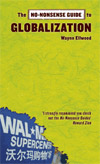 Globalisation: the ticket to a democratic world of instant communications and global prosperity? Or a money-mad juggernaut, spinning wildly out of control? This book traces the journey towards a "borderless" world, looking at what has gone wrong and the way ahead. Buy
Labels: Globalisation, Politics
Cornia, Giovanni Andrea (Ed). Inequality, Growth, and Poverty in an Era of Liberalization and Globalization
 Based on an extensive review of relevant literature and an econometric analysis of inequality indexes, this volume provides the first systematic analysis of the changes in within-country income inequality over the last twenty years. In particular, it shows that inequality worsened in seventy per cent of the 73 developed, developing, and transitional countries analysed, and evaluates possible causes for this widespread rise in income inequality. Buy
Labels: Development, Globalisation, Politics
Butler, C.T. and Keith McHenry. Food Not Bombs
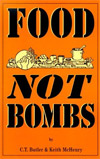 Food Not Bombs grew from a small anti-nuke collective into a decentralised international organisation with autonomous chapters throughout the world. This book is an indispensable resource for challenging capitalism, through the direct redistribution of food. Buy
Labels: Development, Globalisation, Politics
McMichael, Philip D. Development and Social Change: A Global Perspective (Sociology for a New Century Series)

Philip McMichael provides a narrative of how development came to be institutionalised as an international project, pursued by individual nation-states in the post-colonial era. This new edition has been updated and revised to incorporate the treatments of fundamentalism, terrorism, the AIDS crisis, and the commercialisation of services via the World Trade Organisation. Buy
Labels: Development, Globalisation
Middleton, Neil (eds. et al). Negotiating Poverty: New Directions, Renewed Debate
Over one and a half billion people live on the equivalent of less than one US dollar a day. As the gap between rich and poor continues to grow, more people than ever before live below the poverty line and their numbers will increase. Development aid has helped in some cases, but in general, it has failed seriously to reduce destitution. Buy
Labels: Development, Globalisation, Politics
Ransom, David and Anita Roddick. The No-Nonsense Guide to Fair Trade
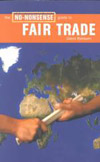
From coffee farming in Peru and cocoa production in Ghana, to the manufacture of jeans in China and the Banana War of Guatemala and the Caribbean, this No-Nonsense Guide tells the human story behind the products we consume. Buy (New Int. Bookshop link)
Labels: Development, Globalisation, Politics
Runge, C. Ford, et al. Ending Hunger in Our Lifetime: Food Security and Globalization (International Food Policy Research Institute)
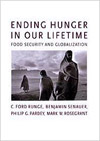 "The book offers a clear explanation of the agricultural problems confronting the world's hungry. But its value lies in putting these physical challenges in a wider social context, looking at other factors, such as women's education, which affect household food security... It also challenges popular misconceptions -- for example, that patents on genes held by multinational companies are hampering farmers in developing countries... [and it] provides a lucid discussion of the problems, and tremendous promise, of trade liberalisation.": Economist review. Buy
Labels: Globalisation, Politics
Sachs, Jeffrey. Forward by Bono. The End of Poverty: Economic Possibilities for our Time
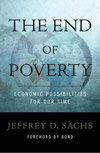 Celebrated economist Jeffrey Sachs has a plan to eliminate extreme poverty around the world by 2025. If you think that is too ambitious or wildly unrealistic, you need to read this book. His focus is on the one billion poorest individuals around the world who are caught in a poverty trap of disease, physical isolation, environmental stress, political instability, and lack of access to capital, technology, medicine, and education. The goal is to help these people reach the first rung on the "ladder of economic development" so they can rise above mere subsistence level and achieve some control over their economic futures and their lives. Buy
Labels: Development, Globalisation, Politics
Black, Maggie. The No-Nonsense Guide to International Development
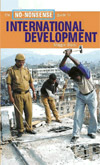 Building dams in India, rescuing street children in Brazil - these are images of aid with which we can all identify. What few people realise is that the terms 'overseas aid' and 'international development' often mask confusion, contradiction, and even downright deceit. Buy
Labels: Development, Globalisation, Politics
Stiglitz, Joseph E. Globalization and Its Discontents

An experienced economist, Joseph Stiglitz had a brilliant career in academia before serving for four years on President Clinton's Council of Economic Advisors and then three years as chief economist and senior vice president of the World Bank. His book clearly explains the functions and powers of the main institutions that govern globalization--the International Monetary Fund, the World Bank, and the World Trade Organisation--along with the ramifications, both good and bad, of their policies. Buy
Labels: Globalisation
Stiglitz, Joseph E. Making Globalization Work
 Four years after his global bestseller "Globalization and its Discontents", the author now brings the story up to the present, examining how change has occurred even more rapidly since then, proposing solutions and looking into the future. Here he puts forward radical new ways of dealing with the crippling indebtedness of developing countries, a new system of global reserves to overcome international financial instability, and an economically incentivised framework for dealing with energy pollutions which create global warming and which threaten us on a planetary scale. Buy
Labels: Globalisation
Woods, Ngaire. The Globalizers: The IMF, the World Bank, and their Borrowers

No other book provides such an elegant introduction to the principal lending operations of both the IMF and the World Bank. With exceptional clarity and grace, Woods strikes a balance between analysis and constructive criticism. Her portrait of the contemporary evolution of the policies and practices of the IMF and World Bank seamlessly integrates an impressive range of research and journalistic coverage.
BuyLabels: Globalisation, Politics
Barnett, Tony and Alan Whiteside. Aids in the 21st Century: Disease and Globalisation
 In only two decades, the epidemic of human immunodeficiency virus (HIV) infection and AIDS has progressed from being a medical curiosity to its current status as a global killer. Tony Barnett, professor of development studies at the University of East Anglia in the United Kingdom, and Alan Whiteside, director of the Health Economics and HIV-AIDS Research Division at the University of Natal in South Africa, have written a book that examines the social and economic effects of the HIV-AIDS epidemic, failures in responding to the epidemic, and what must be done to combat the epidemic. Buy
Labels: Globalisation, Health, Politics

Subscribe to Posts [Atom]


