Gill, Peter. Body Count: Fixing the Blame for the Global Aids Catastrophe

Twenty-five years on, with twenty million dead and another forty million infected, AIDS is the world's worst epidemic. But the catastrophe could have been prevented. Body Count explains how millions could have been saved and many million more infections could have been prevented if the world had responded properly to the crisis.
BuyLabels: Globalisation, Health, Politics
Guest, Emma. Children of Aids: Africa's Orphan Crisis
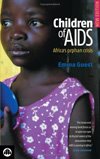
Guest, a freelance writer on AIDS-related matters, concentrates on the neglected and perhaps most helpless and vulnerable victims of the AIDS epidemic...the millions of street orphans from all over Africa, especially in such sub-Saharan countries as South Africa, Zambia, and Uganda.
BuyLabels: Children, Ghana, Health, Kenya, Politics, Tanzania, Uganda
Hunter, Susan S. Black Death: Aids in Africa
'This is one of the most important books on AIDS to be published during the last several years. The picture of the epidemic is gripping; more, it's presented in compassionate human terms, and the scientific questions she raises about disease and evolution are quite intriguing. The book is chilling and fascinating in equal measure. It's a splendid read' - Stephen Lewis, UN Special Envoy for AIDS.
BuyLabels: Health, Politics
Irwin, Alexander and Joyce Millen. Global AIDS: Myths and Facts, Tools for Fighting the AIDS Pandemic
AIDS is the most devastating communicable disease in history, and structures of poverty and injustice are magnifying the crisis in under-resourced countries. Irwin and Millen demonstrate that it is morally imperative and practically feasible to control the spread of AIDS by overturning common myths about treatment and prevention.
BuyLabels: Health, Kenya, Politics
Nolen, Stephanie. 28 Stories of AIDS in Africa
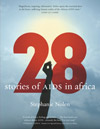
Nolen puts a very human face on HIV/AIDS in
Africa, verbally and visually. A photograph accompanies each of the book's 28 personal histories (one subject stands for one million infected people in sub-Saharan
Africa). The faces in the photos appear no different than faces of everyday Americans, but that appearance belies the horrific reality of lives shredded by devastating disease.
Labels: Biography, Ghana, Health, Kenya, South Africa, Tanzania, Uganda
Bourke, Dale Hanson. The Skeptics Guide to the Global AIDS Crisis: Tough Questions, Direct Answers
 "After reading the first paragraph and faced with the statement, 'Three million people die each year from AIDS, a death toll that has been compared to twenty fully loaded 747s crashing every single day for a year', it seemed evident that there was more to this disease than I first thought. I remembered how many stories I saw on the news about airplanes crashing and the news coverage that followed. I can't remember the last news story I watched about AIDS" - Amazon Review. Buy
Labels: Development, Ghana, Health, Kenya, Rwanda, Tanzania, Uganda
Booth, Karen M. Local Women, Global Science: Fighting AIDS in Kenya
 There is evidence that women who live in societies that uphold male privilege - the majority of the world's women - are at increased risks for HIV infection. Booth looks closely at the operation of two clinics for sexuality transmitted diseases in Nairobi, Kenya, and explores how internationally funded and nationally sanctioned intervention to stop the spread of HIV have focused almost exclusively on the sexual and reproductive behaviour of those who are least able to challenge male power and dominance - working class and poor women. Buy
Labels: Health, Kenya, Women
Thomas, Lynn. Politics of the Womb: Women, Reproduction and the State in Kenya
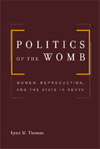 By examining the political signifacance - and complex ramifications of - reproductive controversies in twentieth-century Kenya, this book explores why and how control of female initiation, abortion, childbirth, and premarital pregnancy have been crucial to the exercise of colonial and postcolonial power. Buy
Labels: Health, History, Kenya, Politics, Women
Usdin, Shereen. The No-Nonsense Guide to HIV/aids

Twenty-two million people have died from AIDS-related illnesses since it was first discovered almost 25 years ago. This Guide covers the origins of the disease, the way it spreads, the profits made by drug companies,
women's special vulnerability, and the positive action being taken by people and communities to fight back.
BuyLabels: Development, Health
Barnett, Tony and Alan Whiteside. Aids in the 21st Century: Disease and Globalisation
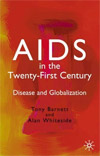 In only two decades, the epidemic of human immunodeficiency virus (HIV) infection and AIDS has progressed from being a medical curiosity to its current status as a global killer. Tony Barnett, professor of development studies at the University of East Anglia in the United Kingdom, and Alan Whiteside, director of the Health Economics and HIV-AIDS Research Division at the University of Natal in South Africa, have written a book that examines the social and economic effects of the HIV-AIDS epidemic, failures in responding to the epidemic, and what must be done to combat the epidemic. Buy
Labels: Globalisation, Health, Politics

Subscribe to Posts [Atom]


