:: Y A R O S L A V L
The ancient Russian town of YAROSLAVL stands on a high, step bank of the Volga River surrounded by boundless forests.
In the beginning of the 11th century, Kiev Prince Yaroslav-the-Wise, wishing to secure the borders of his principality, mounted a campaign against the bellicose pagan tribe living in this part of the country. He subdued them and killed the sacred bear, whom the heathens worshiped. To secure his victory Prince Yaroslav ordered the construction of a fort. This is how, according to legend, the town of Yaroslavl originated. The town's coat of arms depicts a bear holding a pole-axe.
In the beginning of the 13th century, the town became the capital of the independent Rostov and Suzdal principality, and soon after, like the other towns in northeast Russia, it was invaded by Tatar and Mongol hordes.
The first to rise against the Golden Horde were the freedom-loving residents of Yaroslavl. In 1257, Prince Konstantin led the Yaroslavl warriors against the invaders, but they all perished in the bloody and uneven struggle. Beyond the Kotorosl river in Yaroslavl stands the Tugov hill (hill of sorrow), to which people came to weep and pay homage to those who perished. The Tatar and Mongol yoke lasted over two centuries.
In time the devastated town of Yaroslavl was re-built and in the 15th century it united with Moscow. By the 16th century Yaroslavl became one of the major trade centers of Russian state.
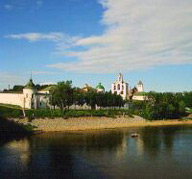
The Transfiguration monastery, the greatest architectural ensemble in Yaroslavl dates to this period. It was a mighty fort on the Volga, as well as a cultural center. At present it houses the historical museum with more then two hundred thousand exhibits-icons, ancient manuscripts, miniatures, books, archeological and numismatological finds, ancient household items, religious objects, clothing and wood carving.
In 1610, when Moscow was captured by the Polish and Lithuanian invaders, Yaroslavl, for a shot time, became the capital of the Russian state. Here in Yaroslavl the national heroes Minin and Pozharsky gathered a force of over twenty thousand that set out on a campaign to liberate Moscow.
In the 17th century, Yaroslavl played an even increasing role in the life of Russian state. In territory and number of residence it was second only to Moscow. At this time the construction of stone buildings, primarily churches was begun and different handicrafts developed. Throughout the 17th century the local stone-masons, artists, caulkers, iron-smiths, carvers and craftsmen working with gold and tiles developed the original Yaroslavl branch of Russian folk crafts.
With construction of St. Nicholas Nadeina church (1620-1622) and Nativity church (1635-1644) stone masonry begins to flourish in Yaroslavl. And architects began to discard strict symmetry in favor of compositions making freer use of space.
The churches of Yaroslavl are famous not only for their unique architecture, but for their fresco-paintings, as well. The churches, interiors are richly decorated by frescos on mythological, historical and religious topics. Many of these frescos, executed in the vivid artistic manner popular in 17th century in Yaroslavl, have been restored and freed of later coats of paint.
In the 18th century like other Russian towns, Yaroslavl began to be, built-up according to plan. The layout of the central district was perfected, streets were straightened and widened and attractive house that are standing still, appeared. In the 19th century trade rows were built and embankment was remodeled. And in the beginning of this century the First Russian Professional Drama Theatre (by Fyodor Volkov) was built.
Near the juncture of the Volga and Kotorosl rivers, the site were the city originated, there is now a park. Here a monument, with an eternal flame, was constructed in honor of labor and military deeds of the city's residents.
The embankment in Yaroslavl is one of the most attractive on the Volga. Here stand the Palace of the Metropolitan (17th century) and Governor's Palace. The latter houses the city's art museum with a good collection of icons and works by the outstanding Russian painters - K. Briullov, I. Kramskoi, N. Rerikh, V. and K. Makovsky and A. Savrasov.
Yaroslavl is now one of the country's major industrial, cultural and educational centers with the population approximately 600 000 people.
The residents of the city are proud of their famous compatriots - the poet N. Nekrasov, the educator K. Ushinsky and the opera singer L. Sobinov. Valentina Tereshkova, the world's first woman cosmonaut, is a native of the city. Recently, in her honor the Museum of Space Exploration was opened in the city.
Click here to return to the Russia program page.
|